

This tale is adapted from the story “Fisherman Plunk and His Wife” by Ivana Brlić-Mažuranić which can be found in Croatian Tales from Long Ago. Ivana Brlić-Mažuranić is considered the Hans Christian Anderson of Croatia and every year her hometown, Ogulin—as haunted a landscape as ever there was one—holds a fairy festival. I hope that my reinterpretation does justice to the original tale.
Amber Joy
Long, long ago a poor fisherman lived in a little house on a desolate coastline nestled between harsh mountains and a harsher sea. Every day he’d take his little boat out on the water and every day he’d bring it back only a few fish richer—for in those days the people of his land had not yet learned of nets and every fish he caught was caught with a single bone hook. Life was hard and the fisherman soon found himself dissatisfied. For he had heard of great kings and knights, rich sheriffs and magistrates, men of power and wealth who lived in luxury and comfort. It was said that such men wore jewels on every finger, ate on plates of gold, and dressed in only the finest silks and velvets. Their skin was soft and their bellies full of the sweetest meats and rarest truffles. The fisherman would hear these tales and look at his own life and only see want. His skin was rough with work and weather, his clothes made of wool and skins and patched by his own hands. He ate fish every day on plates of clay. Rather than a palace he lived in a small house, he built his ownself. Everything he had he toiled for. Nothing came easy.
Deciding that he had to do something to gain himself the wealth other men had, the fisherman cast a spell that only fishermen can cast: he took his little boat out to the middle of the sea, and there he stayed, bobbing in the water, not eating, not sleeping, and most importantly not fishing—though, of course, he had the equipment to do so. For three days and three nights, he stayed doing nothing but watching the eastern horizon. As the third night ended and dawn teased a pale sliver of far off light, a silver boat with golden sails rose slyly out of the sea, at its helm was the Dawn Maiden, as beautiful and wonderous as the dawn itself.
“Good fisherman,” she said, “for three days and three nights you’ve spared my fish your hook, and for that I thank you and would grant you a boon. What is it you wish for?”
“I am tired of my harsh and lonely life, Maiden,” the fisherman replied, “Every day I toil for naught. There is no joy for me in the world at all.”
“Hmm,” said the Maiden, “Go home, fisherman, and you will find what you need.”
The fisherman hurried home and when he arrived back at his little house nestled between the mountains and the sea there on his doorstep sat a very tired but pretty woman. When she saw him she stood.
“Sir,” she said, brushing the dirt from her skirts, “I buried my mother in yon mountains. I am alone in the world and tired of traveling. If you take me as your wife I promise I will be good to you.”
The fisherman hardly knew what to do. He could see that the woman was sad and tired and at least as poor as he was—if not more so—but she was pretty and he was lonely and he thought, “She might be the gift the Dawn Maiden sent me. It would be bad luck to turn her away.” So he consented and invited the woman inside where she promptly went to sleep and did not wake again for two whole days. On the third day, she woke, and on the fourth, they wed.
On the day of their wedding, the fisherman could scarcely contain himself wondering how his good fortune would show, but nothing extraordinary happened. The day after they were wed, the fisherman took his little boat out to catch some fish and his wife went up the mountains to gather wild spinach, herbs, and mushrooms. They came home around the same time, then cooked and ate dinner together. After dinner, the fisherman sat down in front of the fire and his wife sat down beside him and began to tell him stories to while away their time together.
She told him stories of kings and castles, of knights and dragons and hoards of gold, of princesses who sow their gardens with pearls and reap precious gems. While the fisherman listened his heart sang with joy and he forgot he was poor, he forgot his struggles, he forgot his loneliness. He could have sat there forever, wife tucked under his arm, listening to her stories. “Ah,” he thought, “my wife is a fairy-woman. She talks so casually of kings and dragons. She can lead me to the riches I need. I only need to wait.“
And wait he did.
One night turned to two, turned to three, turned to a year, and then another. They had a son together, a sweet little boy who filled his parents’ hearts full to bursting with joy. And the fisherman’s wife’s stories grew more elaborate and fantastical. And still, their days were much the same: the fisherman going out on his boat and his wife going up to the mountains. The fisherman’s life, though much changed, still wasn’t anything like he imagined when he was granted a boon by the Dawn Maiden and he soon grew dissatisfied again. Greed and envy bloomed within him and that small voice of want that lives within us all grew loud: Where were the riches he dreamed of? Where were the castles, the servants, the easy life? He began to grow resentful of his wife. Wasn’t she meant to bring him such things?
As the days passed, the fisherman grew more and more impatient until one evening as his wife was telling him about the treasures found in the Sea King’s palace the fisherman jumped up and said, “Wife, I am tired of tales. I want the truth! Tell me the way to the Sea King’s palace that I may see these treasures for myself.”
“What?!” his wife said, shocked that he would say such a foolish thing. “What do you mean?”
“I know you are a fairy-woman,” the fisherman said, “a gift from the Dawn Maiden meant to lead me to riches beyond my imaginings. Else why would you come to me? Why would you fill my head with tales of treasure and magic and ease? Tell me how to get to the Sea King’s palace.”
“I—I do not know,” replied his wife, “I’m no fairy. These are just stories to while away the time. I cannot give you what you want.”
“Then what use are you?” the fisherman yelled, angry now because he knew she was a fairy-woman sent to him by the Dawn Maiden. She was his gift meant to bring him riches and ease his life of desolation and hardship. Why would she lie to him and deny it? He already knew it to be true. “The Dawn Maiden told me I would get what I need to lift myself out of desolation and she sent me you. If you can’t bring me riches, then what good are you?”
The fisherman’s wife, shocked by his anger, more than a little hurt by his sudden outburst, and honestly worried that she’d married a madman, gathered up their son and muttering something about not putting up with such nonsense, locked herself in their bedroom. She didn’t come out until the fisherman had left for the sea the next morning and she made sure to be locked right back in before the fisherman came home that afternoon. He’d get no more stories from her if he was going to act the fool. She wasn’t even sure she wanted to talk to him again at all.
When the fisherman came home with his catch, he cleaned and cooked the fish for their dinner as he usually did, but his wife did not join him. There were no smiles or songs, no laughter or kind and teasing words. After the fish was cooked she came out of their bedroom, gathered enough to feed herself and their son, and went right back in the bedroom leaving the fisherman all alone. She did not even offer him any of the greens or mushrooms she gathered that day. The fisherman was sure she had gathered some because he could smell the lingering aroma of her wild mushroom soup—a personal favorite of his—in the air around the stove.
After dinner, the fisherman sat by fire alone. He could hear the laughter of their son and the murmurs of his wife but he could not make out any words and when he tried to join them they fell silent. The door remained locked. The fisherman stared into the fire glumly. He was sad and lonely and confused—if only his wife would talk to him, would tell him how to get to the Sea King’s palace or some other treasure hoard they could be rich beyond her wildest dreams, she could live in comfort the rest of her life, they could be happy. Why wouldn’t she tell him what she knew and he knew she knew. And if she wasn’t going to tell him, she could at least come out of the bedroom and lean her head against his shoulder like she used to and they can talk of other things to while away the time.
This went on for a whole week and then another. His wife was gone. The fisherman would sometimes see her but she would not speak to him. When he tried to talk to her—which was every time he saw her—he would ask about the Sea King’s palace and the treasures found therein, and she would tilt her head in such a way to tell him of her disappointment and walk back to the bedroom without saying a word. Sometimes she looked like she might cry! He did not see their son at all.
The truth is the fisherman missed his wife and he missed their son, though he was too much a fool to recognize it. Instead, he brooded and thought and thought and thought and made a decision. He would find riches without his wife and bring them back for her and she would forgive him. And so he went to cast a spell that only fishermen are able to cast…
After three days and three nights of bobbing in the water in the middle of the sea without eating or sleeping or fishing, the fisherman was once again face-to-face with the Dawn Maiden in her silver boat with golden sails. And when he spoke to her he complained bitterly.
“I’m worse off than before,” he whined, “I’ve a missing son and a mute wife. My home is as dreary as a grave!”
The Dawn Maiden stared at the fisherman silently for a long heartbeat before replying, “What do you want? I will help you just this once more.”
The fisherman, the fool, could think of nothing but seeing and enjoying the Sea King’s palace and treasure; so he didn’t wish to see his son again or that his wife would speak to him again, instead he begged the Dawn Maiden:
“Fair Maiden,” he said, “tell me the way to the Sea King’s palace.”
Again the Dawn Maiden was silent a moment, and she tilted her head in such a way as to remind the fisherman of his wife of late, but when she spoke it was to say:
“When day dawns at the next New Moon, get into your boat, wait for the wind, then drift eastward with it. The wind will carry you to the Isle Bountiful, to the stone Gold-a-Fire. And there I shall be waiting for you to show you the way to the Sea King.”
The fisherman went home, giddy with anticipation. That was only a few days away!
When day dawned at the New Moon the fisherman shot out of his house at first light, got in his boat, waited, and then drifted eastward with the wind.

The wind caught the boat and carried it along to the Unknown Sea and then to the Isle Bountiful. The Isle Bountiful floats upon the sea like a garden. The grass grows thick, the meadows lush, the vines are full of fruit, and the trees pink with blossom. Right in the middle of the island is the precious, white-blazing stone, Gold-a-Fire. Half of the stone lies above the ground, giving warmth and light to the land. The other half of Gold-a-Fire illuminates the sea under the island in a pearlescent glow. The fisherman guided his boat through the meadow and the grasses and flowers parted for him like the waters of the seas and made his way to Gold-a-Fire. He could just make out the Dawn Maiden sitting on top of the stone, waiting to show him the way to the Sea King.
Very kindly did the Dawn-Maiden receive the fisherman, and very kindly did she set him on his way. She showed him a mill-wheel drifting on the sea towards the island, and the mermaids dancing in a ring around the wheel. Then she told him—always very kindly—how he must address the mill-wheel politely and taught him the spell to ask it to take him down to the Sea King and not let the Dark Deeps of the Sea swallow him.
Last of all the Dawn-Maiden said:
“There is a great store of gold and treasure in the Sea King’s domain. But mark—you cannot return to earth for three terrible watchers bar the way. One troubles the waves, the second raises the storm, and the third wields the lightning.”
But the fisherman did not hear her, not after she mentioned treasure, for his thoughts went to it and his wife and how if he could only prove himself this way maybe she would speak to him again. He paddled to the mill-wheel, through the mermaids that played around it, and when he reached it he held his paddle aloft so the Dark Deeps would not swallow him and politely addressed the mill-wheel as the Dawn Maiden had instructed him:
“Round wheel giddy-go-round, please take me down, not to the Dead Dark Deep but to the Sea King’s Palace Keep.”
As the fisherman spoke, the mermaids came swishing along like so many silver fish, they swarmed around the mill-wheel, seized the spokes in their snowy hands, and began to turn the wheel—swiftly, giddily. Their laughter rang painfully in the fisherman’s head and he could not help but notice how sharp their teeth were as an eddy formed in the sea. The eddy grew fiercer and fiercer until it became a terrible whirlpool that caught him and swept him round like a twig and sucked him down, down to the Sea King’s fastness.
The fisherman’s ears were still ringing with the swirl of the sea and the mermaids’ terrible laughter when he suddenly found himself sitting on fine and beautiful sand whose grains were made of purest gold. He let out a “whoop!” of joy, danced a pretty dance, and looked around the great field of gold in which he stood. Only it wasn’t a field but the Sea King’s great hall. Around the Hall stood the sea like a marble wall, and above the Hall hung the sea, like a glass dome. Down from the stone Gold-a-Fire streamed a bluish glare, livid and pale as moonlight. From the ceiling hung festoons of pearls, and on the floor below stood tables of coral.
The Sea King himself lounged at the far end where reedy musicians played slender pipes and tiny bells, watching the little human who dared to enter his home, his great bull’s head tilted this way and that as the fisherman danced. Beside the Sea King was a coral table laden with all the delicacies of the sea and behind him a golden hedge.
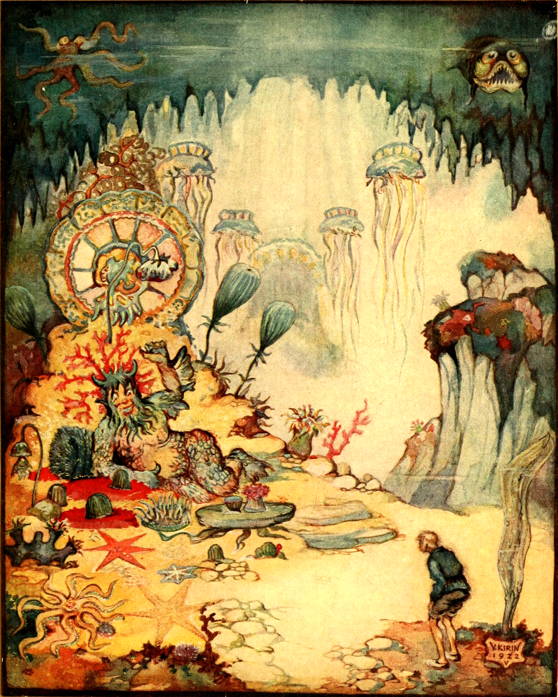
With the quick, shrill music of the pipes, the tinkling of the bells, and the sheen and glimmer all around him, Plunk wouldn’t have believed there could be so much pleasure or wealth in the world! He went mad with the wonder of it all. He sang, he clapped his hands, he ran and tumbled and danced, he went head over heels once, twice, thrice! Just like a frolicsome child.
Now this amused the Sea King greatly and he guffawed as he lounged in the sand; laughing so heartily that the golden sand blew up all around him.
“Come here, human,” the Sea King called to the fisherman. The fisherman came and the King continued, “You are quite light on your feet, my boy. It is a delight to see! You must feast with me.”
The fisherman heartily agreed.
With that, the Sea King reached up and up and up—longer than his arm should go—and pulled down a branch laden with pearls from the ceiling which he presented the fisherman much to the fisherman’s delight. The Sea King also signaled to his servants, the fairies of the sea, to bring forth food and drink. He gave the fisherman leave to sit beside him at the great coral table, and surely that was a great honor!
After the fisherman had eaten and drunk his fill, the Sea King, looking at him with hungry bull eyes that were so far past madness as to seem quite sane, said, “I much enjoyed your dancing and tumbling from earlier. Do it again.”
And what could the fisherman do to deny the King? Nothing. So he danced and tumbled and tumbled and danced for hours and hours and days and days with little rest and little food. And the fisherman, now long healed from his original madness, feared for his life and despaired for all that he left behind. He missed his wife and son and the life he had with them. He realized now, too late, how rich his old life was—how rich his family made him. The fisherman often wept bitterly for this but his tears washed away in the seas surrounding the Sea King’s palace so no one ever noticed but him.
His wife, though, had not been idle.
 Knotting the Wind